

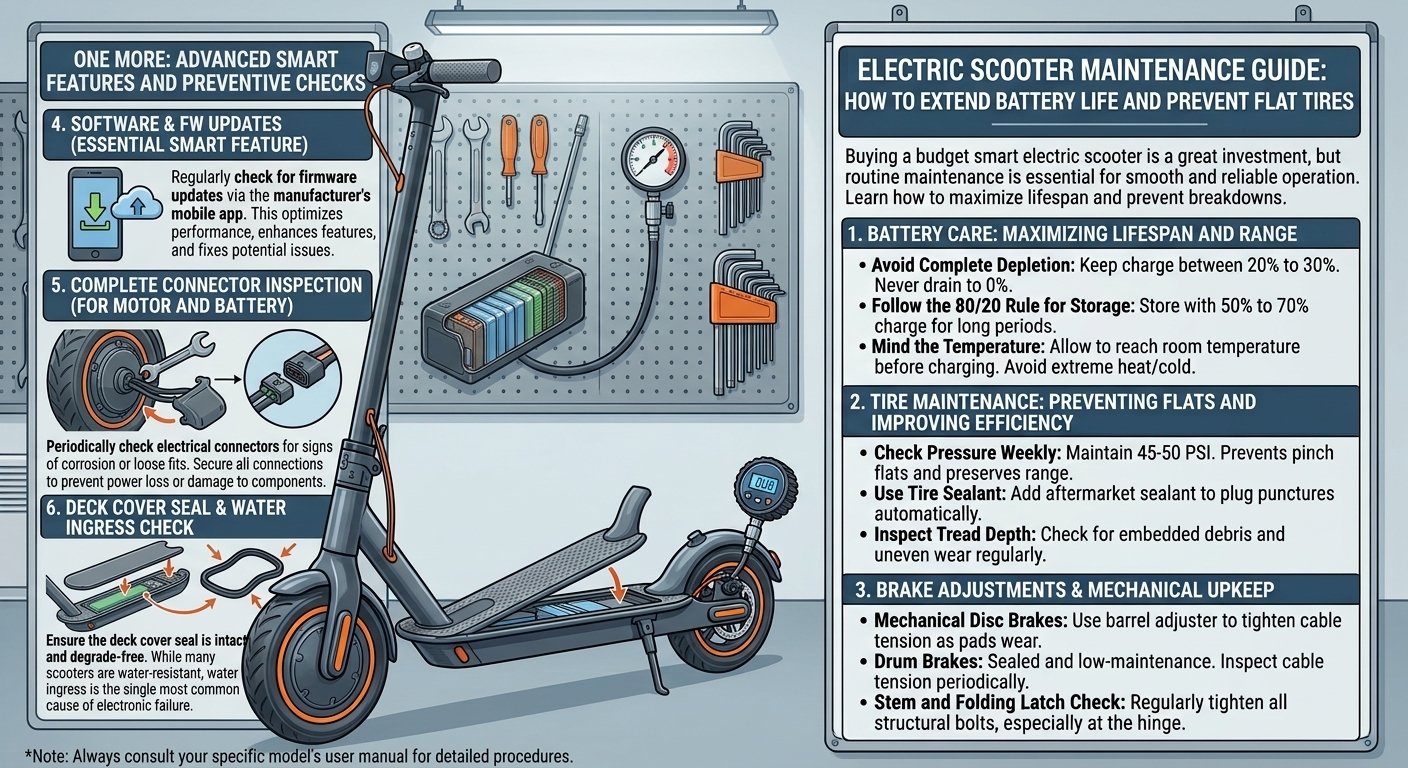
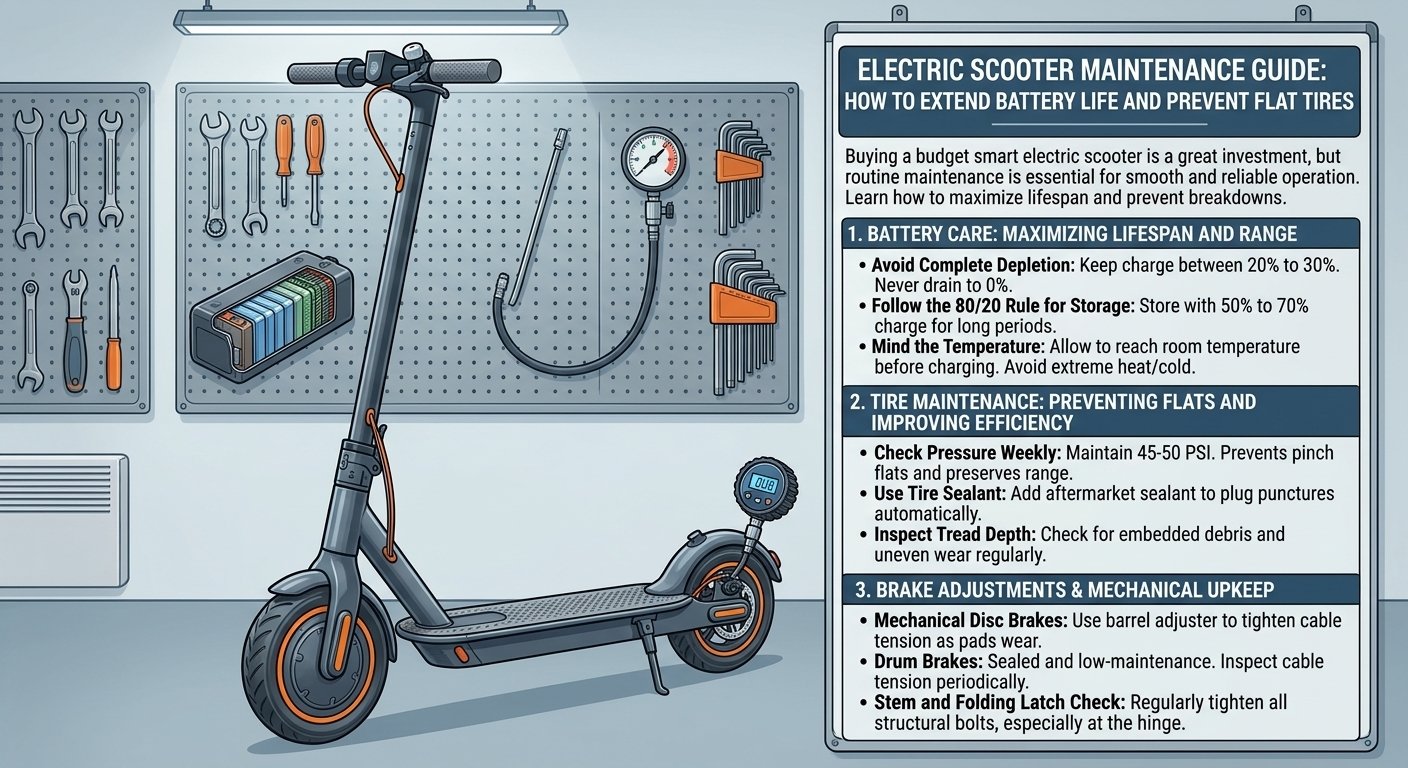
Buying a budget smart electric scooter is a great investment, but routine maintenance is essential to ensure it runs smoothly and reliably for years. Whether you ride a Segway Ninebot Max G2, a NIU KQi 300X, or any other sub-$800 commuter, following a few fundamental care habits will maximize your battery’s lifespan, maintain peak range, and prevent unexpected breakdowns.
1. Battery Care: Maximizing Lifespan and Range
The lithium-ion battery pack is the most expensive single component on your electric scooter. Proper charging and storage habits can double its usable lifecycle.
- Avoid Complete Depletion: Try not to let your battery drain down to 0%. Lithium-ion batteries experience the most stress at extreme charge states. Recharge your scooter when it reaches 20% to 30%.
- Follow the 80/20 Rule for Storage: If you plan to store your scooter for more than a few weeks, leave the battery charged to roughly 50% to 70%. Storing a fully depleted or 100% full battery for months causes capacity loss over time.
- Mind the Temperature: Never charge a battery immediately after a long ride when it is still hot, and never charge it in sub-freezing temperatures. Allow the battery to reach room temperature before plugging in the charger.
2. Tire Maintenance: Preventing Flats and Improving Efficiency
Tire pressure directly impacts your top speed, acceleration, range, and ride safety. Under-inflated tires increase rolling resistance and make pneumatic tires far more susceptible to pinch flats.
- Check Pressure Weekly: Maintain your tire pressure between 45 to 50 PSI (or the manufacturer’s recommended level printed on the tire sidewall). Low pressure can drop your real-world range by up to 20%.
- Use Tire Sealant: For standard pneumatic tires without self-healing gel layers, adding an aftermarket tire sealant (like Slime or Armor-Dilloz) can automatically plug punctures up to 1/8-inch as you ride.
- Inspect Tread Depth: Regularly check for embedded glass, sharp debris, or uneven tread wear to ensure optimal traction on wet asphalt.
3. Brake Adjustments & Mechanical Upkeep
Reliable stopping power is critical for urban commuting. Different brake types require specific upkeep:
- Mechanical Disc Brakes: Over time, brake cables stretch and pads wear down. Use the barrel adjuster near the brake lever or caliper to tighten cable tension when you notice increased lever travel.
- Drum Brakes: Drum brakes are sealed against dirt and water, requiring very little maintenance. Inspect the brake cable tension every few months to maintain a firm lever feel.
- Stem and Folding Latch Check: Periodically check and tighten all structural bolts—especially around the folding hinge and handlebars—using a set of Allen wrenches to eliminate stem play and wobbling.
Quick Maintenance Checklist
| Frequency | Task | Benefit |
| Weekly | Check tire pressure (45–50 PSI) | Prevents flat tires and preserves range |
| Bi-Weekly | Wipe down frame & check brake levers | Keeps electronics clean & ensures stopping power |
| Monthly | Tighten stem hinge & chassis bolts | Eliminates wobble & ensures structural integrity |
| Quarterly | Inspect tire tread & clean battery contacts | Maintains traction & prevents charging issues |